
In mid-July 1518 a woman in Strasbourg began to dance, and within days she was not the only one. John Waller, in Endeavour in 2008, says fear paralyzed the city and the elite despaired. The minutes are what the council wrote down. The argument further on is his: despair after famine and disease, belief in a saint's curse, and a public cure that let the distress spread. None of it is a diagnosis of the woman, or of the boy, or of anyone else on the sheet.
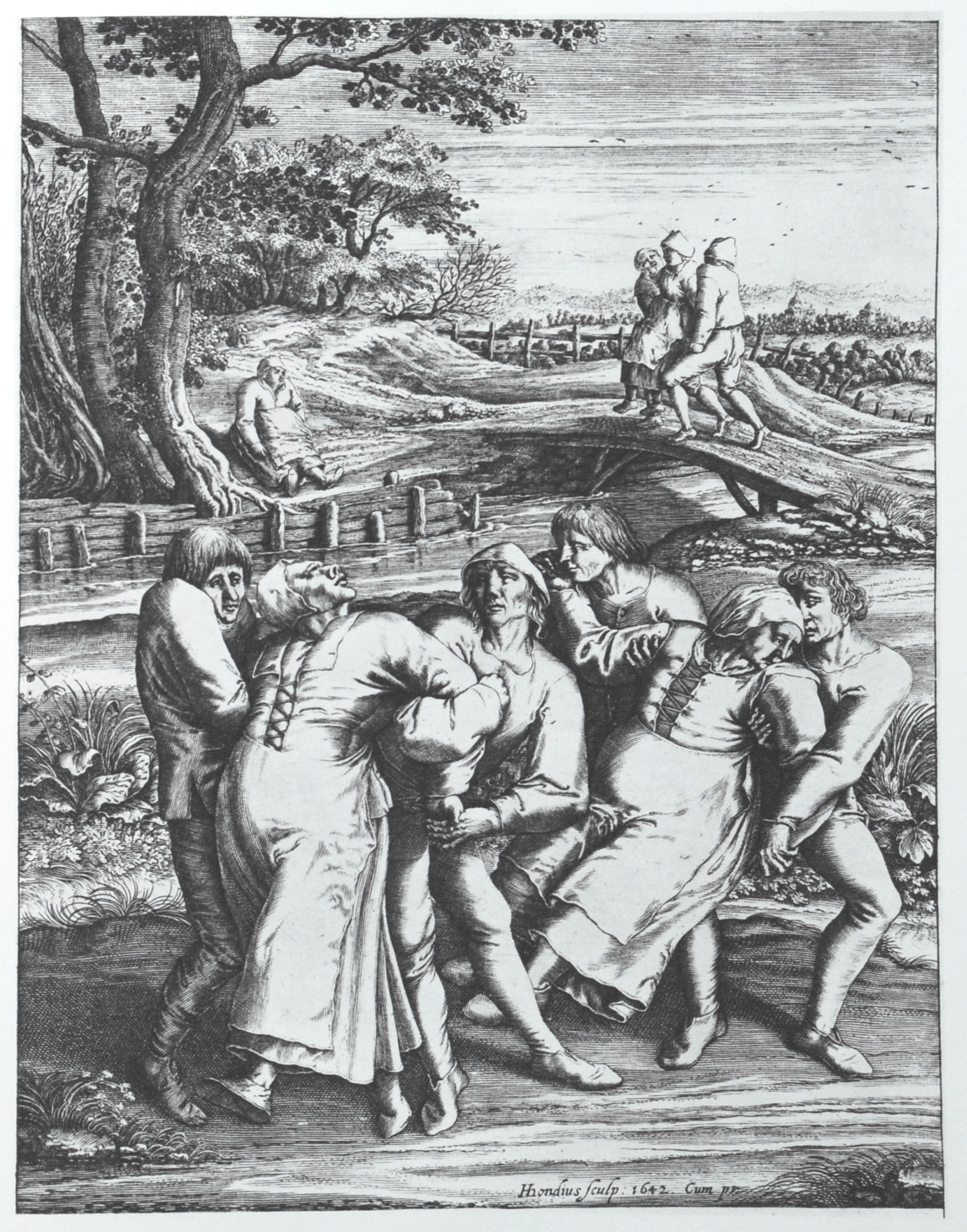
The print above is not Strasbourg, and it is not 1518. Hendrik Hondius cut it in 1642 from a drawing Pieter Bruegel the Elder made in 1564. Three women are held up by the men beside them. John Waller, in Endeavour in 2008, transcribes the note on Bruegel's sheet. These are the pilgrims who were to dance on St John's Day at Muelebeek outside Brussels, and when they have danced over a bridge and hopped a great deal they will be cleansed for a whole year of St John's disease. The file is public domain, on Wikimedia Commons.
Eight days before Mary Magdalene
Alfred Martin, in the Zeitschrift des Vereins für Volkskunde for 1914, prints a Strasbourg family chronicle. In 1518, eight days before St Mary Magdalene, a woman began to dance. It lasted a good six days. The lords had her taken to St Vitus at Zabern, later Saverne, and there she was quiet. While she was still on the road, more people started by the magistrates' stables, about thirty-four women and men within four days. The lords forbade drums and pipers. One party went to the tanners' hall, the other to the carpenters' hall. The next day all of them were taken to St Vitus, and they danced there. Within four weeks, in the copy Martin prints, the number is more than four hundred.
Four hundred is that book's total. A later account tied to Oseas Schad, and the Duntzenheim chronicle, both of which Martin sets beside it, say more than two hundred. An extract from the Council of Twenty-One says that around St Margaret's day as many as fifty persons danced day and night, pitiful to see.
Those fifty, the extract goes on, were kept at the city's expense and led to St Vitus in the Hohlenstein near Zabern, and nearly freed of it. Then the lords published an order. Nobody was to dance until Michaelmas, 29 September, anywhere in the city and its jurisdiction, on pain of thirty shillings, and nobody was to beat a drum. Weddings and first masses might still use stringed instruments, according to conscience.
The tanners' hall, the carpenters' hall, and the ban on drums are already in this chronicle. The claim that those choices made the outbreak worse is not. That claim is Waller's.
The Friday after
Mary Magdalene's day in 1518 was Thursday 22 July. The Friday after is the 23rd. Martin prints the minute from the city archive, shelfmark G U P 200, and he had the sheet. Appointed lords sat for the poor who were dancing and sent for the burghers with kin among them.
Balthasar Burgawer, schoolmaster behind the Franciscans, said his son Bernhart had been watching. That morning, when the boy should have been helping with the children, he began to dance. The father shook him until afternoon. After two o'clock Bernhart wanted the dance, and had to be taken. Burgawer offered to pay. He had no wife and no servants, and he could not leave the school.
Antheng Silinger, a wagon-maker, was asked about his wife Apolonia, dancing in the carpenters' hall. He had come in from the harvest. She had been standing in the room and hopped up. He asked three times how she was, thought it was St Martzolff again, the falling sickness she had had before, and pushed her down. Then poor people came past with a bagpipe. She jumped up and ran after them. He would have taken her to the saint. She was, he said, a poor woman.
The two answers sit in the same minute. A schoolmaster's son who had been watching. A wagon-maker's wife who ran after a pipe. Keep them. The psychology has nothing firmer than this, and it is not a diagnosis of either of them.
The poor go in three groups, on wagons the hospital and the cathedral fabric are told to furnish. The dorse, as Martin prints the title, is the instruction for the poor dancing persons sent to St Vitus at the Holenstein. Near Zabern a rider goes ahead and, with the dean, hires three or four priests. Each group hears a sung mass and is led around the altar. Each offers a penny, or the leader lays the coin. Zabern is the name in the minute. Saverne is the same town. The Holenstein is a cave chapel about thirty miles off, in the hills.
Another extract from the same protocols has the physicians call it a natural sickness from hot blood. The bishop's vicar thought a special rite unnecessary, the doctors having said the thing was natural and natural means should be tried. He would still have the preachers ask for prayer from the pulpit.
A stage, sixty years on
The wooden stage, the partners on wages, and the red shoes are in Daniel Specklin, born in Strasbourg in 1536. Martin quotes the chronicle as Rodolphe Reuss reconstructed it. Young and old danced day and night until they fell, more than a hundred at once. The council, Specklin says, lodged them in guild halls and built scaffolds on the horse market and the grain market, and paid people to dance with them to drums and pipes. Nothing helped. Many danced themselves to death. Wagons then took them to St Vitus at the hollow stone. They were given little crosses and red shoes, mass was said, and crosses of chrism were put on the shoes, above and below, with holy water in the saint's name. That, he writes, helped nearly everyone. Fraud, he adds, ran in the crowd, and the dance also struck people who had been cursed with it.
Waller, in the Endeavour essay and in A Time to Dance, a Time to Die (Icon Books, 2008), sets the stage opposite the horse fair and has the city hire the band so the sick would dance the hot blood out. He has the governors reverse themselves after weak hearts and strokes. The reverse is dated in the papers: wagons on 23 July, drums already forbidden, a ban through Michaelmas. The scaffold and the red shoes are Specklin's, about sixty years later. The minute does not contain his stage.
Fifteen, and what it counts
Wilhelm Rem, edited by Friedrich Roth in the city chronicles, volume 25 (Leipzig, 1896), is the line Martin uses to fix 1518 and to throw out 1418. In the summer of 1518, Rem writes, St Vitus's dance came upon very many at Strasbourg, so that on one day it came upon a good fifteen people. It lasted long, and so dancing, piping, and drumming were forbidden.
Fifteen there is a count of people seized on a bad day, reported from Augsburg. No death is in the sentence. Waller, writing in The Lancet on 21 February 2009, says one chronicle states that the outbreak claimed, for a brief time, about fifteen lives a day. That wording is his. The council sheet does not have it. The first "many danced themselves to death" Martin can show is Specklin, and then Michael Kleinlawel's rhymes of 1625. A daily corpse-count of fifteen is a later reading of a chronicle. The Afterlife of a Rumor is what happens when the sentence travels anyway.
Johann Schilter, in 1698, printed a verse about many hundreds dancing in Strasbourg and put it under the year 1418. Martin shows that year migrating into the medical books. The manuscript Schilter cited burned in the library fire of 1870. When the Archive Burns is another city, and the same kind of hole.
What drove the outbreak
In Endeavour, Waller says the dancers expressed fear and desperation, and that in lucid moments they asked for help. He finds no evidence they wanted the dance. Fear, in the essay's opening, had paralyzed the city, and the elite despaired. His question is what follows if widespread despair had already pushed people into a trance. The saint, he argues, is why that trance came out as a dance. In the Lancet on 21 February 2009 he says the epidemics were driven by pious fear. High distress makes an involuntary trance more likely, which is how a person might keep moving on feet that are already swollen and sore. That is a reading of chronicles. Nobody examined these people.
He is careful about the calendar. Harvest failure, plague, and war do not, he notes, usually end in a dancing mania. The decades before 1518 were still unusually harsh, even for a valley used to fear. Serious famines in and around Strasbourg in 1492, 1502, and 1511. The summer of 1516 scorched the crops. Bread went to a price few had paid. A chronicler he cites called 1517 the bad year.
Waller thinks the years before 1518 were hard even for this valley: wrecked harvests, cruel bread prices, the French pox among newer sicknesses. Syphilis had come in the 1490s. He has a leading citizen, in 1495, speak of a bad pox, and he sets the return of leprosy, smallpox, and the plague beside it. The Lancet adds a succession of appalling harvests, the highest grain prices in more than a generation, and acute distress in Alsace, bitter even by the standard of that age. In The Psychologist on 16 July 2009, famine, sickness, and terrible cold caused widespread despair in Strasbourg and its environs, in the decade before the dance. Despair, in this argument, is what the hunger and the sickness had already done.
The belief did the shaping. The region already had a saint who could curse you into dancing and whose chapel, the belief ran, could take it off. Chronicles, Waller writes in Endeavour, had the onlookers decide that the first woman was cursed by St Vitus, which is why she was taken to the shrine at Saverne. Along the Rhine, "God give you St Vitus" and "May St Vitus come to you" were already curses, not jokes. In the Lancet he says dancing was thought to be both the affliction and the cure, and that some who had briefly recovered their wits danced themselves back under, expecting only that to lift it. A frightened person who slipped into a trance had a script. The town already knew what a curse from that saint was supposed to look like.
Hot blood was the doctors' noun. A later favourite was ergot, the mould on damp rye. E. Louis Backman argued in 1952 that its poisons, which can convulse a person and disorder the sight, lay behind the dancing manias. Waller answers, in Endeavour, that those chemicals do not allow sustained dancing. They can trigger violent convulsions and delusions. Days of coordinated movement are another matter. Bernhart started after he watched. Apolonia started after a bagpipe. The council's move was to silence the drums and carry people to a saint. In 1374, Waller writes, a dance of the same shape spread from around Aachen, Liège, and Maastricht toward Ghent, Utrecht, Metz, Trier, and at length Strasbourg, among people who believed the devil or St John had cursed them, after a disastrous flood on the Rhine and the Moselle. A bad loaf in one city does not draw that line of towns.
A crowd turns a private distress into one shared behavior when the belief and the view arrive together. Waller, in Endeavour, says that seeing another person in the trance makes the watcher more likely to enter it, because the watcher already expects a spirit, or a saint, to take the body. There is a script, and exposure to someone already inside it makes the next person readier. The Lancet calls the spread a psychic contagion.
In The Psychologist he is plainer about Strasbourg. The people were convinced St Vitus had unleashed a dancing curse, so the trance followed that myth and came out as days of dancing. The dance became an epidemic, as in 1374, because each new victim made the supernatural story more credible. Distress came out as a trance, on his account, and spread because the dancers were on view. He calls that mass psychogenic illness: his name for a belief, and for Bernhart and Apolonia in a minute, not a chart signed after an examination. Bernhart's father said the boy had been watching. Silinger said a bagpipe passed and his wife ran. Suggestion does not need a shared loaf. It needs a shared fear and a body you can see.
You might be thinking the council was only getting them off the street. The family chronicle already puts one party in the tanners' hall and the other in the carpenters' hall, and it forbids drums and pipers, so the music was already part of what the lords thought they had to stop. Specklin, about sixty years later, has the scaffolds on the horse market and the grain market, and partners on wages, with drums and pipes. Waller, in Endeavour, has them clear the guildhalls and the grain market, build the stage opposite the horse fair, and pay musicians and professional dancers so the sick would dance day and night. The hot-blood cure was more dancing, not less.
In the Lancet he calls that policy a disaster. The strategy, he writes, helped spread a psychic contagion, and nothing could have been better calculated to turn the dance into an epidemic than making the victims perform it in the most public spaces. In The Psychologist he says the authorities ensured that the outbreak got out of control by having the dancers gathered and left to dance in some of the most public spaces in the city. A hall gets a collapsing person off the lane. It also gives Bernhart something to watch. The minute of 23 July does not contain Specklin's stage. It contains the halls, the wagons, and a drum ban already in force. The worsening, as a mechanism, is Waller's. The rooms are the council's.
H. C. Erik Midelfort, as Waller quotes him, said illnesses of the mind in the past are not petrified entities that can be plucked unchanged from their niches and placed under our modern microscopes. Against Diagnosing the Dead is that rule at full length.
Burgawer had no wife and no servants, and he could not leave the school. Silinger had come in from the harvest. He called Apolonia a poor woman and said he would have taken her to the saint. The chronicle's first dancer was already on the road to Zabern while the next thirty-four began by the stables. The paper shows households short of care. Burgawer had nobody who could stay, and Silinger had been away at the harvest. Waller is the one who adds a city short of bread and health. Put those together and you have people cut off from safety, which is his picture, not a diagnosis. A secure base, in the plain sense this site uses, is a person who stays when you are frightened. The council's offer, in the minute, was a hall and a wagon. In Specklin, and in Waller's account of the hot-blood cure, it was a stage and a band. A stage is not comfort. It is a place to be seen. Attachment language can ask who stayed and who was sent down the road. It cannot sign a chart on Bernhart, or on Apolonia, or on the woman the chronicle does not name.
The chronicle says a woman. Paracelsus, in a chapter on what people called St Vitus's dance, names Frau Troffea. She danced, on his telling, because nothing vexed her husband more, other women copied her, and belief turned the performance into a sickness the town gave to the saint. The chapter has no city and no year. Waller attaches the name to Strasbourg in mid-July. Britannica repeats Frau Troffea, or Trauffea, and says a number died of the exertion. The sheet of 23 July still says a woman.
For a person actually in the house, the words for who stays are with the Secure Base downloads. Those pages are for the living. They will not file Bernhart.
Keep the Friday sheet in mind the next time fear runs through a house you know. Burgawer could not leave the school. Who, in that house, can leave the work and stay?
Sources
- Alfred Martin, Geschichte der Tanzkrankheit in Deutschland, Zeitschrift des Vereins für Volkskunde 24 (1914), pp. 113-134
- Wilhelm Rem, Chronika newer geschichten, ed. Friedrich Roth, Chroniken der deutschen Städte 25 (Leipzig, 1896), as quoted by Martin
- John Waller, In a spin: the mysterious dancing epidemic of 1518, Endeavour 32 (2008)
- John Waller, A forgotten plague: making sense of dancing mania, The Lancet, 21 February 2009
- John Waller, A Time to Dance, a Time to Die (Icon Books, 2008)
- John Waller, Dancing plagues and mass hysteria, The Psychologist, 16 July 2009
- Britannica, Dancing plague of 1518
- Wikimedia Commons, File:Die Wallfahrt der Fallsuechtigen nach Meulebeeck.jpg (public domain)
 History: Un-Attached
 Searching for Bowlby
 Mrs. Orcutt's Driveway
