
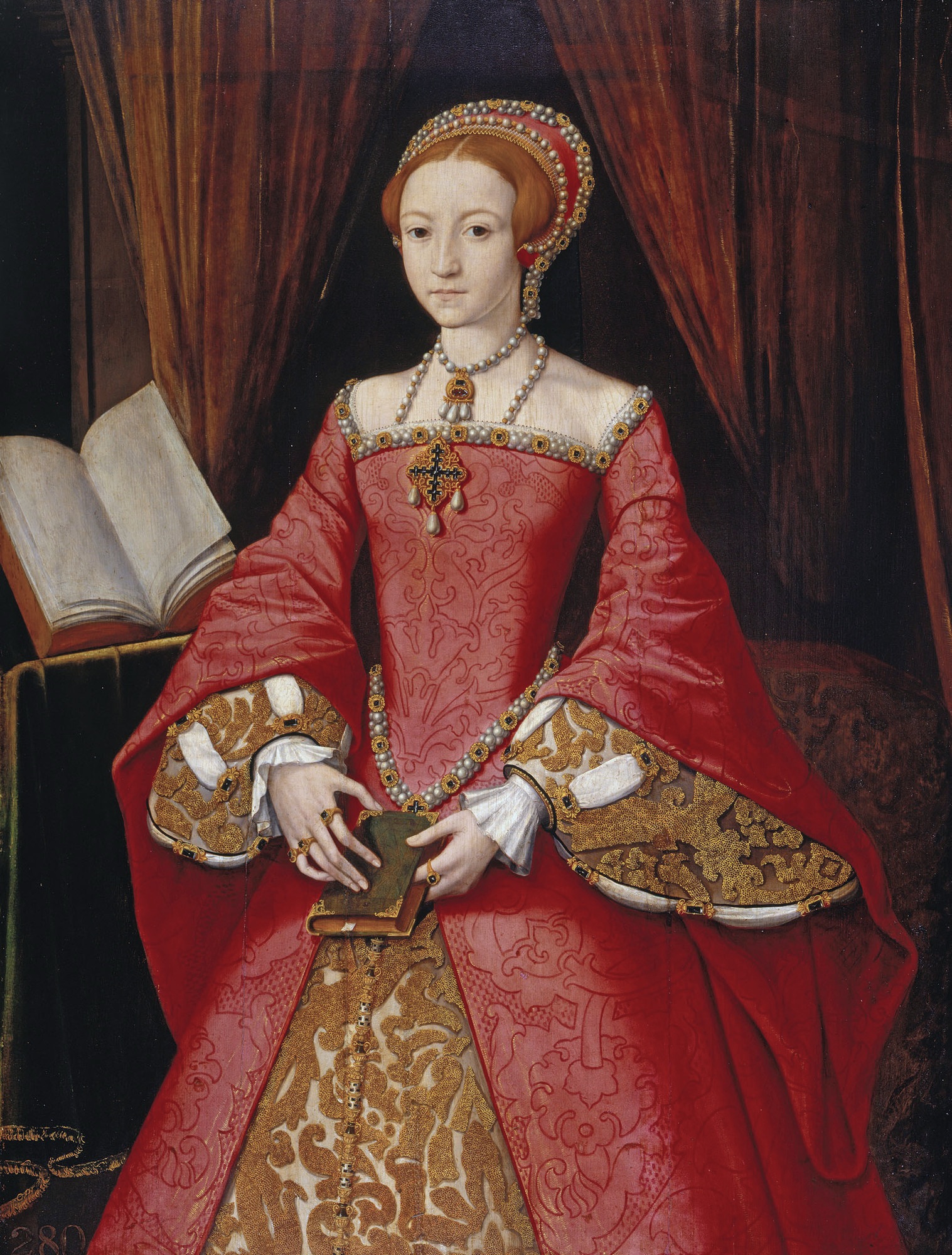
The panel above is Elizabeth at about thirteen. The Royal Collection calls it Elizabeth I when a Princess, puts it around 1546 or 1547, and attributes it, with a hedge, to William Scrots. Oil on oak, RCIN 404444. A list from her brother Edward's collection already notices a picture of the Lady Elizabeth "with a booke in her hande her gowne like crymsen clothe." A book flatters a schoolroom. It will not tell you who sat up with her after the title was taken back. The photograph is in the public domain under the Creative Commons Public Domain Mark, and the file is on Wikimedia Commons.
She was born at Greenwich on 7 September 1533. Anne Boleyn was executed on 19 May 1536, which is two years and eight months, not the round "three" retellings prefer. Parliament then treated the marriage as void from the start, so the child was illegitimate and the style of princess came off her. Britannica records the gap that matters: the emotional impact was not written down.
The surviving paper from that summer is about clothes and a chair. In August 1536 Margaret, Lady Bryan, wrote to Thomas Cromwell from Hunsdon. The sheet is damaged, Cotton Otho C.x, and the readable text is the calendar in Letters and Papers. Elizabeth had been put from the degree she was in, and what degree she was at now Bryan knew only by hearsay, so she did not know how to order the child, herself, or the women and grooms. The raiment had run out. No gown, no kirtle, no petticoat, no linen for smocks, and none of the small pieces, down to the calendar's "begens," nightcaps. Sir John Shelton, who said he was master of the house, wanted her at the board of estate for dinner and supper. Bryan wanted a plain mess in the child's own lodging, because there was no place of correction at the board and the girl was too young to correct much. The same letter calls her as toward a child, and as gentle of conditions, as any Bryan had known. Praise, with a bill pinned to it. Not a report of grief.
Jane Seymour died the autumn after Edward was born. Catherine Howard was executed in February 1542, when Elizabeth was eight, and the letters do not say what she understood of it. Katherine Parr, married in July 1543, is the stepmother who does appear. She put the lessons where the court could see them, and after Henry died in January 1547 she kept Elizabeth in her household.
Chelsea, then Hatfield
Parr married Thomas Seymour, the Lord Admiral, and Elizabeth, thirteen and then fourteen, lived with them at Chelsea. The confessions taken in the winter of 1549, calendared in the Cecil Papers, are specific. Katherine Ashley said the Admiral came into the chamber before Elizabeth was ready, sometimes before she was out of bed. Up, she was struck on the back or the buttocks. In bed, he opened the curtains, made as though he would come at her, and one morning tried to kiss her. At Hanworth the queen came with him, and the two of them tickled the girl in the bed. Thomas Parry said Parr found the Admiral holding Elizabeth in his arms, fell out with them both, and that the houses split for that reason. Elizabeth went to Cheshunt. Her letter, National Archives SP 10/2, spells it Cheston and dates itself only "this present Saturday." The archive puts it about June 1548. She had been, she told Parr, replete with sorrow to depart, the more so for leaving her unsure of her health, and she had weighed Parr's offer to warn her of any evil spoken of her. Parr died on 5 September 1548, after childbirth.
Seymour went on talking of a marriage. Arrested in January 1549, he took Ashley and Parry into the inquiry with him. Sir Robert Tyrwhitt sat at Hatfield to get a story from a girl of fifteen. On 22 January he told the Protector she would not confess any practice by Ashley or the cofferer. On the 23rd he added the line that still sounds irritated, because it is: a very good wit, and nothing gotten of her but by great policy. On 28 January she wrote herself. Rumors were abroad against her honour and honesty, "which above all other things I esteem." The rumors were that she was in the Tower and with child by the Lord Admiral. "My lord, these are shameful slanders." She asked to come to court after the Council's determination, "that I may show myself there as I am."
The next letter is for the governess. On 7 March, a proclamation against the rumors having gone out, she wrote again. British Library Lansdowne MS 1236, folio 35, is the original Henry Ellis printed. Ashley had been with her a long time, and had taken great labor and pain in bringing her up in learning and honesty. Then Elizabeth borrowed Gregory: we are more bound to them that bring us up well than to our parents, for parents do what is natural, which is to bring us into the world, but bringers-up are a cause to make us live well in it. She also said the awkward part. If the woman she loved so well stayed in prison, men would think the deed had been pardoned in Elizabeth only because she was young. Tyrwhitt had watched that tie already. On 19 February, when his own wife was put in Ashley's place, Elizabeth said she had not so demeaned herself that the court need put any more mistresses upon her. She wept all that night and, the calendar's word, lowered all the next day. The love she bore her old mistress was, he thought, to be wondered at. Ask who stayed. Do not sign the chart. That limit is already drawn in Against Diagnosing the Dead. Gregory's sentence is a brief from March 1549. It is not Bowlby.
Blanche Parry had been there since the birth. Her tomb in St Margaret's, Westminster, as John Strype copied it, calls her chief gentlewoman of the privy chamber and keeper of the jewels, "whom she faithfully served from her Highness's birth." She died a maid in her eighty-second year, on 12 February 1589 by the stone, February 1590 once the old calendar is corrected. At Bacton the verse she prepared names the cradle. Marion Colthorpe's Elizabethan Court Day by Day, at the Folger, transcribes "whose cradle I saw rocked." Ashley died in 1565. Parry was still in the room.
The Tower, and the husband she would not take
At noon on 17 March 1554, from Whitehall, Elizabeth wrote Mary. Wyatt's rising had failed, and the Council was sending her to the Tower. SP 11/4/2 is the Tide Letter. A boat had to catch the low tide under London Bridge, and this one missed it. The National Archives says she wrote slowly enough to lose the tide. The page, at any rate, is what we have. She asked Mary to make good an old saying, that a king's word was more than another man's oath, and not to condemn her without answer and due proof. She had neither practised, counselled, nor consented to anything prejudicial to Mary's person or dangerous to the state. She asked to answer before the queen herself, because she was not allowed to bow the knees of her body, and she scored the blank above the signature so a sentence could not be inserted. The Tower took her on 18 March. Woodstock had her from May. Foxe, later, has her sit in the rain and refuse the name of traitor. The letter does not need that scene.
On 20 November 1558, at Hatfield, three days after Mary died, she charged William Cecil, in the words taken down as SP 12/1. He would be of her Privy Council and take pains for her and the realm. He would not be corrupted with any manner of gift. He would be faithful to the state, and without respect of her private will he would give the counsel he thought best. She kept him until his death in 1598. Later letters call him her Spirit. The years are countable. A temperament is something added on top.
Parliament asked her to marry on 10 February 1559, and the reply did not survive as a single text. Camden's later account, printed by Leah S. Marcus, Janel Mueller, and Mary Beth Rose in Elizabeth I: Collected Works, has her say she was already bound unto a husband, the kingdom of England, and show the coronation ring. Another report of that afternoon leaves a marriage open if the man would care for the common good, and pictures a marble stone declaring that a queen, having reigned such a time, lived and died a virgin. In February 1560 she wrote Eric XIV of Sweden, who meant to sail over and woo her. The National Archives translation of SP 70/11 is blunter than Camden. She had never yet conceived that kind of affection toward anyone. She did not conceive in her heart to take a husband, but highly commended the single life. A diplomatic no. Still hers, and still on paper, which the ring story is only at second hand.
Robert Dudley had been near that court since they were young. He was already in the Tower when she arrived on 18 March 1554, and still there when she left in May. The overlap is real. A conversation from those weeks is not. Amy Robsart died at Cumnor on 8 September 1560, and a marriage after that was politically rotten, whatever the inquest found. Elizabeth did not make it. She created him Earl of Leicester in 1564 and kept him close until he died in September 1588. One reading sees a known man held near, and a husband's power refused. Another sees a queen who had watched her father's wives, Mary's Spanish match, and Seymour, and who could send a favourite from court in a way she could not send a king consort. Bowlby named those patterns four centuries later. Bonds Before Bowlby Had a Name is why the gap is the point, not a nuisance. Darwin could see which face a baby reached for. A word he never had will not diagnose a queen.
The public face, once she ruled, is another file. When the Portrait Is a Mask keeps it. This panel is only the girl with the book.
For a child who is actually in the house, the language lives with the Secure Base downloads. Those pages are for the living. They will not gloss Hatfield.
Whose name in that household would you find hardest to replace, and which sentence would you need on the table before you said why?
Sources
- Letters and Papers, Henry VIII, vol. 11, no. 203, Lady Bryan to Cromwell, August 1536
- National Archives, Elizabeth I's monarchy, part one (SP 10/2, SP 11/4/2, SP 12/1, SP 70/11)
- Calendar of the Cecil Papers, vol. 1, 1549, Tyrwhitt and the Ashley confession
- Elizabeth to Somerset, 7 March 1549, British Library Lansdowne MS 1236, fol. 35
- Royal Collection Trust, Elizabeth I when a Princess, RCIN 404444
- Wikimedia Commons, File:Elizabeth I when a Princess.jpg (public domain, CC PDM 1.0)
- John Strype, Survey of London, monument of Blanche Parry at St Margaret's, Westminster
- Marion E. Colthorpe, The Elizabethan Court Day by Day, 1590, Folger Shakespeare Library
- Marcus, Mueller, and Rose, eds., Elizabeth I: Collected Works (University of Chicago Press, 2000)
- Britannica, Elizabeth I
 History: Un-Attached
 Searching for Bowlby
 Mrs. Orcutt's Driveway
