
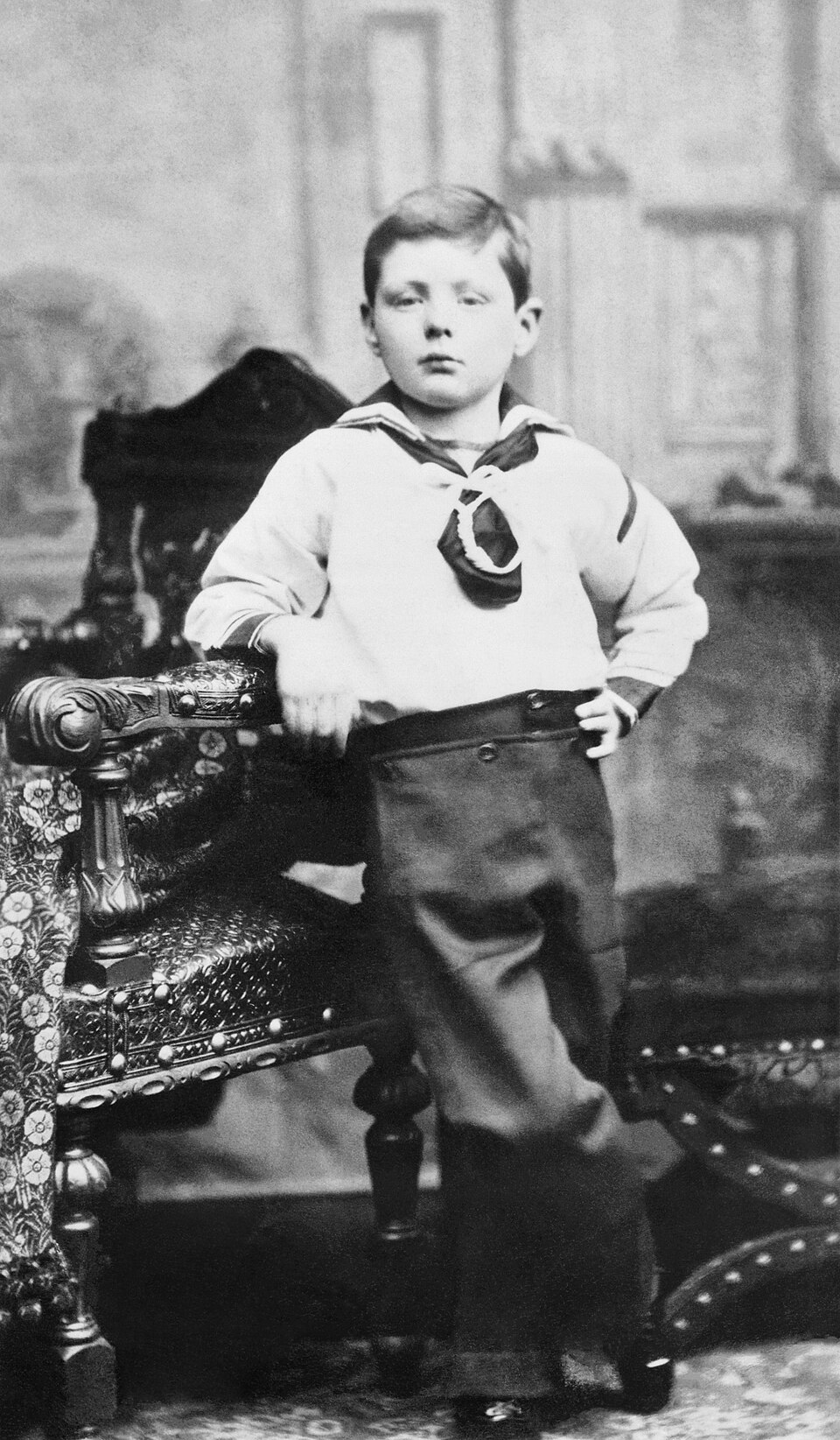
The print above is a boy in a sailor suit. The Imperial War Museums file it as ZZZ 7555D and call him Winston Churchill at seven, in Dublin, in 1881. Jack was born at Phoenix Park on 4 February 1880, and by 10 April the household was at 29 St James's Place, so a Dublin sitting at seven is hard to place. The International Churchill Society says that if this is the Irish photograph it belongs before that move, when he was five, and before school either way. What the file shows is the suit. The copy is a UK Government photograph, public domain once Crown copyright expired, on Wikimedia Commons.
He was born at Blenheim on 30 November 1874. In My Early Life (1930) the sentence he keeps for his mother has been quoted until it sounds smooth. It is still his. "She shone for me like the Evening Star. I loved her dearly — but at a distance." The next lines name the person in the room. "My nurse was my confidante. Mrs. Everest it was who looked after me and tended all my wants. It was to her I poured out my many troubles, both now and in my schooldays." Elizabeth Ann Everest came at the start of 1875. He called her Woom, or Woomany. The "Mrs" was what the nursery called her.
Ascot, Brighton, Harrow
In November 1882, a few weeks before he turned eight, he went to St George's, Ascot. The headmaster was the Reverend Herbert William Sneyd-Kynnersley, and the cane was part of the house. On 17 June 1883, CHAR 28/13/17, he wrote "My dear Mamma, I hope you will come and see me soon." Had Everest handed over the "flour." Love to his "ants." He was "comeinge home in a month." On 8 June 1884 the archive summary has him asking her for the 24th, and asking that Everest and Jack be allowed to come.
Ascot ended that summer. In October 1884, CHAR 28/13/44, he wrote to Everest herself, "My dear Oom," and told her he had been ill. "I shall soon be looking for a visit from you so you must ask Mamma to let you come and see me with Jack." The school by then was the Misses Thomson, Brunswick Road, Brighton. On 17 March 1886 he was seriously ill there with pneumonia.
Harrow took him on 17 April 1888. Finest Hour 160 counts that autumn: six of nine letters to his parents asked them to come. His father did not. His mother came once. Ahead of her he wrote, "try and come early because it spoils my afternoon to wait at the Railway Station," and "Do let me know because it is rather 'stale' waiting." He left in December 1892, still officially in the Lower School, with one prize that stuck: twelve hundred lines of Macaulay's Lays of Ancient Rome, recited without a mistake.
Lord Randolph once inspected the toy soldiers, nearly fifteen hundred of them drawn up in attack, and asked if the boy wanted the Army. Yes, at once. For years Winston thought his father had seen a gift. The memoir's later explanation is colder. Not clever enough for the Bar. Cavalry cadet at Sandhurst on 28 June 1893, in the college on 1 September. The companion volumes print a severe letter from Lord Randolph dated 9 August 1893.
The wet jacket
By autumn 1892, on the memoir's telling, Everest was housekeeper to his grandmother at 50 Grosvenor Square. He remembered a pension after twenty years, and his father taking the savings to Lord Rothschild at New Court to be invested. Finest Hour 175 is sterner. Before his seventeenth birthday he heard she was to go, protested, and saw her placed with the duchess, then lost from there too. He wrote to his mother that to cut Everest adrift at her age was cruel and rather mean. The dismissal came by letter. The pension and the protest are both in the record.
She died of peritonitis on 3 July 1895, at her sister's in north London. Lord Randolph had died on 24 January. Winston, gazetted to the 4th Hussars on 20 February, came up from Aldershot when he heard. There had been a shower. The jacket was wet. She felt it and would not settle until it was dried, for fear he caught cold. She wanted Jack. That could not be arranged. He fetched a specialist, took the midnight train back for parade, and returned when parade was done. She still knew him, then she did not. "She had been my dearest and most intimate friend during the whole of the twenty years I had lived."
He paid for the headstone in the City of London Cemetery at Manor Park, and an annual sum to keep the grave, which the Churchill Centre still pays. At Chartwell a small red-framed photograph of her stands in the study with his wife and his children. In India, reading Gibbon because his father was said to know it by heart, he hit the line on Gibbon's nurse. "If there be any, as I trust there are some, who rejoice that I live, to that dear and excellent woman their gratitude is due." He thought of Everest. "It shall be her epitaph."
Vindicate, then be seen
Called from a nearby house, he ran in the dark over snow in Grosvenor Square. The end was painless. Lord Randolph had been in a stupor. Syphilis was the old story. Roberts, in the 2018 life, sets a brain tumour beside it, and the memoir chooses neither. "All my dreams of comradeship with him, of entering Parliament at his side and in his support, were ended. There remained for me only to pursue his aims and vindicate his memory." He counted three or four long talks. One, at Newmarket in autumn 1892, followed a row over a gun fired at a rabbit under the window. "Do remember things do not always go right with me. My every action is misjudged and every word distorted." Macmillan signed for the biography on 31 October 1905. The two volumes of Lord Randolph Churchill came out on 2 January 1906.
Between those dates he went where a dispatch could be filed. Birthday at Arroyo Blanco, Cuba, 30 November 1895. Bangalore that next October. Malakand in September 1897, the book of it in March 1898, the 21st Lancers at Omdurman on 2 September 1898. The Morning Post took him to South Africa in October 1899. An armoured train near Chieveley made him a prisoner on 15 November. Out of the State Model School in Pretoria on 12 December, Lourenço Marques on the 21st, Durban on the 23rd. He had already lost Oldham, that July, before he sailed.
You might be thinking the risks explain themselves. Parents who would not come, a son who had to be seen. Storr's version sits below, with the limit attached. The dates are also a young officer who could write and wanted a seat.
The minute, and the dog
First Lord from 1911. He proposed the Dardanelles on 3 January 1915. The ships went in on 18 March and came off the mines. Landings on 25 April. Fisher resigned on 15 May. Churchill left the Admiralty on 26 May, took the Duchy of Lancaster the next day, and left the Cabinet on 11 November. The last troops came off in January 1916. The name stayed. From his resignation as Chancellor on 4 June 1929, the chronologies call it the wilderness, until the Admiralty again on 3 September 1939 and the premiership on 10 May 1940. Jenkins, in Churchill (2001), and Roberts tell the next weeks as an argument in a room.
On 26 May the confidential annex has him say that peace under a German domination of Europe "we could never accept," and that he was "opposed to any negotiations which might lead to a derogation of our rights and power." Halifax had heard the Italian ambassador already. France was failing. Italy was not yet in. At 4 p.m. on 28 May he was determined not to have Mussolini stand between Britain and Hitler, and he put decent terms at a thousand to one against. At 7 p.m. he reported the outer ministers' "greatest satisfaction" on hearing there was "no chance of our giving up the struggle." Dalton's diary adds the line about choking in their own blood. The Museum of the Prime Minister prints it. The conclusions already refuse the approach.
Anthony Storr's "The Man," in Churchill: Four Faces and the Man (1969), admits that a psychiatrist who never met him is on risky ground, then goes on anyway. Neglect. A dead father's standard. Work, then the black dog, then work. Readers took it as a diagnosis. The paper is smaller. Mary Soames prints the Home Office letter of 11 July 1911, where he tells Clementine a German doctor had lifted a cousin's depression. "I think this man might be useful to me — if my Black Dog returns. He seems quite away from me now. It is such a relief. All the colours came back into the picture." On 28 January 1916 he asked her to keep the front separate from "those terrible and reasonless depressions." Daniels and Vale, in the Journal of the Royal Society of Medicine in 2018, call that scanty: a metaphor, no examination. Attenborough's 2014 book argues the same at length. Roberts puts the lows after Singapore and Tobruk down to the news. Lady Soames told Richard Langworth that doctors who had never been in the room made too much of it.
Hold the argument there. Against Diagnosing the Dead is the rule this drawer already keeps. A resemblance is not a code.
John Bowlby used "attachment figure" for the person a child looks for when alarmed. Mary Ainsworth's "secure base" is the person you can leave and come back to. The school sheets ask the parents to come. The memoir says the nurse heard the troubles. The Evening Star line, and the vow to vindicate a father he had barely talked to, are what later writers mean by an idealized picture of someone rarely there. They are not a classification. Bonds Before Bowlby Had a Name is why that gap stays open. The same halt is already drawn for a governess in 1549, in Elizabeth I and the People Who Stayed.
He proposed to Clementine Hozier in the Temple of Diana at Blenheim on 11 August 1908. They married at St Margaret's on 12 September. Their daughter edited the letters. The black dog note is addressed to her. On 27 June 1940 Clementine wrote the other kind, the one Packwood and Drake head with a danger of his being generally disliked. Six weeks a Prime Minister, and she was telling him the roughness was costing him the room. A person who stays can also say the unpleasant sentence. The letters were not a chart.
For a child actually in the house, the words live with the Secure Base downloads. Those pages are for the living. They will not gloss the railway station at Harrow.
Whose letter would you answer this week, and which visit have you been putting off because the week looks full?
Sources
- Winston S. Churchill, My Early Life (1930), published in the United States as A Roving Commission
- Letter, Winston to Lady Randolph, 17 June 1883, CHAR 28/13/17
- Allen Packwood and James Drake, eds., Letters for the Ages: Winston Churchill (Bloomsbury Continuum, 2023)
- International Churchill Society, Finest Hour 160, autumn 1888 at Harrow
- Hillsdale College Churchill Project, timeline 1874-1977
- International Churchill Society, Mrs Everest, and Finest Hour 175
- Mary Soames, ed., Speaking for Themselves (1998), the 11 July 1911 letter via the Hillsdale Churchill Project
- Anthony Storr, "The Man," in Churchill: Four Faces and the Man (1969), as discussed by Daniels and Vale, Journal of the Royal Society of Medicine, 2018
- Wilfred Attenborough, Churchill and the "Black Dog" of Depression (Palgrave Macmillan, 2014)
- Museum of the Prime Minister, the Cabinet crisis of May 1940, citing CAB 65
- Imperial War Museums, photograph ZZZ 7555D, and the Wikimedia Commons file (public domain, PD-UKGov)
- Roy Jenkins, Churchill (Macmillan, 2001), and Andrew Roberts, Churchill: Walking with Destiny (Allen Lane, 2018)
 History: Un-Attached
 Searching for Bowlby
 Mrs. Orcutt's Driveway
